Table of Content
That’s why it’s essential to play the deployment of any WiFi extender using a WiFi analyzer app like NetSpot. If you want to boost your WiFi without purchasing a new router, you can start by tweaking your settings. If you haven’t done so already, activate the 5 GHz band to benefit from its greater resistance to signal interference. You should also make sure that your router uses the least cluttered channel possible, especially when using only the 2.4 GHz band.
You might want to use the parental controls feature to put limits on when your kids can use their devices, and what they can do with it. Your speed might be sluggish because others are using your Wi-Fi signal, leaving less for you. If you're using a weak Wi-Fi password, or no password at all, someone may be using your internet without your knowledge. Be sure to get at least a dual-band router, or preferably a triple-band model, and use the 5GHz bands (as we'll explain in a bit). If you're not, contact your ISP and see if there's a problem at their end. If there isn't a problem with them, they might be cheating you out of money for a subpar plan.
Plans & devices
Adding an access point to a home network requires connecting it to the primary router or gateway. A second broadband router can often be used instead of an ordinary AP because many home routers offer an access point mode specifically for this purpose. Consider upgrading the antennas on your routerwith more powerful ones.
Most routers can have a spread of between 100 feet and 150 feet. Your router’s packaging and manual should give you the specific number. If you’ve lost those items, look up the model number on the internet to find its range. For example, you might be categorized as a “high-volume internet user” if you’re streaming a lot of high definition videos. If there’s a particular limit set by your ISP that you exceed, the internet company could slow down your internet until it’s loading at a crawl.
Bonus tip for faster internet
Technologies change rapidly, and one of the best ways to speed up your wireless network is to use the latest hardware. Older, lower performance technologies like Wireless-N (802.11n) and Wireless-AC (802.11ac) are still in most mobile and IoT devices, while other technologies are nearly obsolete. The Netgear Nighthawk X6S EX8000 is a high-end WiFi booster with speeds up to 3 Gbps. Last but not least, consider contacting your internet service provider and asking for help. The devices connected to the Internet use up your router’s bandwidth. Make sure all of the devices you aren’t using are completely turned off so they’re not eating up your wifi signal.
You may even find that there’s an upgrade available to your plan that will increase your download speeds. Just be sure to read the fine print so that you’re actually going to get faster internet speeds. Read our guide to learn how to use a VPN to solve some of the ISP-specific speed issues.
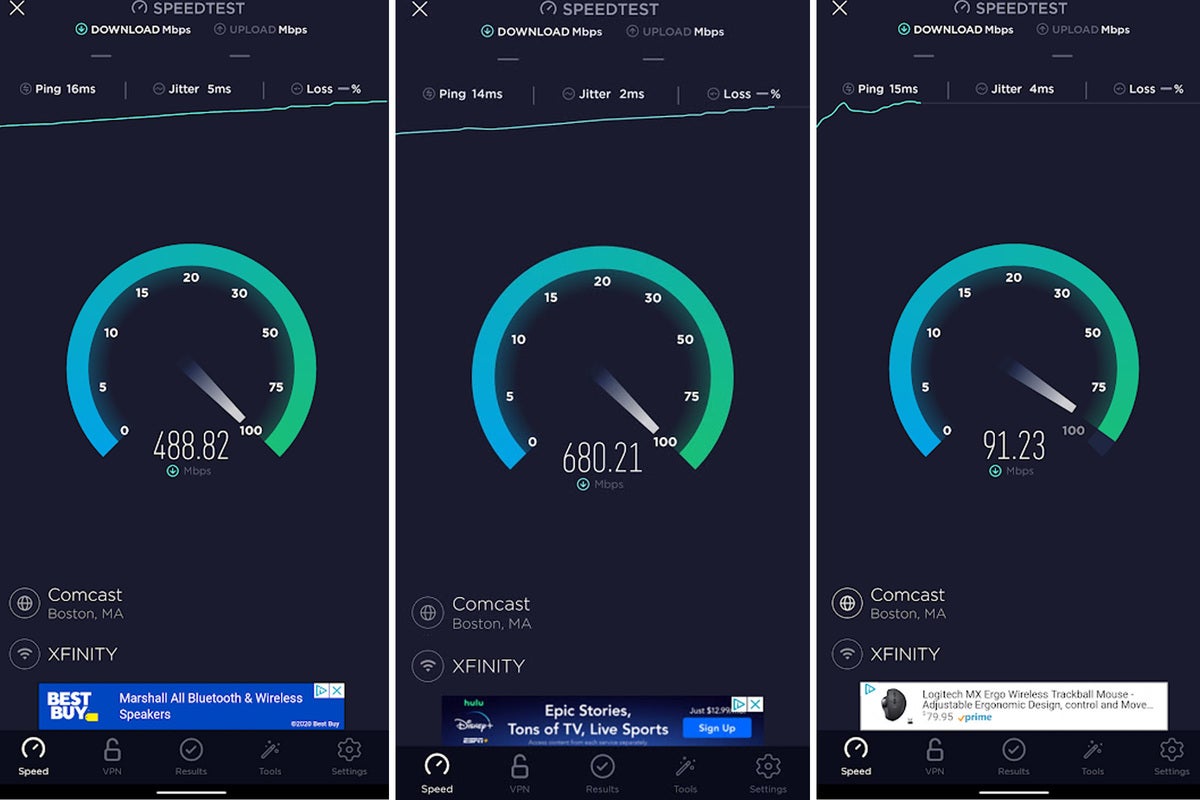
Test your internet speed
But it wasn’t so long ago that almost half of Americans didn’t even use the web. In fact, as recently as the year 2000, only 52% of adults in America were online. It can even help to elevate the router—mount it high on the wall or on the top shelf to get a better signal. The final component of your browser's performance; if your browser has several toolbars or add-ons, removing them will speed up your browser. Especially if your router and/or modem is more than three years old, you'll want to upgrade to a more recent model.
Learn how to improve the overall quality of your wireless connections for streaming videos, music, or chatting with your friends. If you want to dive deeper into this Wi-Fi thing, check out the following articles about Wi-Fi security, the best apps for wireless networking, inflight WiFi, etc. Getting into some detail, not every spot will do for your WiFi router. A router won't do great near metal objects and the appliances that emit electromagnetic waves .
If you suspect range issues, bring your device closer to the actual router. Or, you can use a range extender or amplifier to add coverage to weak signal spots in your home. Home networks and many public hotspots utilize a single wireless access point. This access point has limitations on how many people and devices can be connected to it at once.
There are many public DNS servers you can choose from, including Google’s DNS server (8.8.8.8) or Cloudflare’s DNS server (1.1.1.1). Some routers make it very easy to configure QoS settings, while other routers are far from intuitive. Wait until your router finds and installs the latest firmware. If it takes a long time and your router appears to be unresponsive, give it a few more minutes before you disconnect the router from power and turn it on again. Other problematic appliances are washing machines, tumble dryers, televisions, cordless phones, and radiant heaters.
Still, if none of the rest of these tips solve your problem, it's time to reach out to your provider to ask some questions. Before you buy anything, the first thing you'll want to try doing is repositioning your router to strengthen the connection. For the best results, you'll want to keep it out in the open -- ideally as high up as possible.
However, we all know that there’s also nothing more frustrating than a slow or spotty WiFi connection. It's entirely possible the problem has nothing to do with interference or Wi-Fi range. If your network is open, or has a weak password, you could have an unwanted guest or two piggybacking on your network. If the neighbor is downloading multiple 4K movies on your Wi-Fi, your video chats will suffer.
Your broadband is shared between all the connected devices in your home. The number of devices and how much data each is using can also affect the speed of the service. Getting a better wireless router will give you more options, such as using a faster frequency band or WiFi protocol. You can even get routers that do other things, like hiding your location with VPN routers. Disconnecting other wireless devices — such as home security and smart home devices — from your network has the obvious benefit that they aren’t taking any of your precious bandwidth.
QoS settings can typically be found under advanced settings in the network's administrator interface. Run another speed test to see if that provides a better signal and faster speeds over the Automatic setting in your problem areas. Most routers will choose the channel for you, but if neighboring wireless networks are also using the same channel, you'll encounter signal congestion. A good router set to Automatic will try to choose the least congested channel, but older or cheaper routers may just choose a predefined channel, even if it isn't the best one. If you really want to get the most out of your current router, the adventurous can look at a third-party firmware, like the open-source DD-WRT. This can ramp up performance and give you access to more advanced networking features, including the ability to install a VPN right onto your router.
Let's start with a speed test
If you have any of these appliances at home, keep your WiFi router as far away from them as possible to boost WiFi signal. To start with, you want to avoid placing your router close to metal objects and appliances that emit electromagnetic waves. Metal is the top disrupter of a WiFi signal, and its presence close to a WiFi router can easily create a large dead zone. Check out a video guide on how to boost Wi-Fi signal at home — some tips and tricks as well as how to use NetSpot to see surrounding WiFi networks and perform a WiFi site survey.




No comments:
Post a Comment